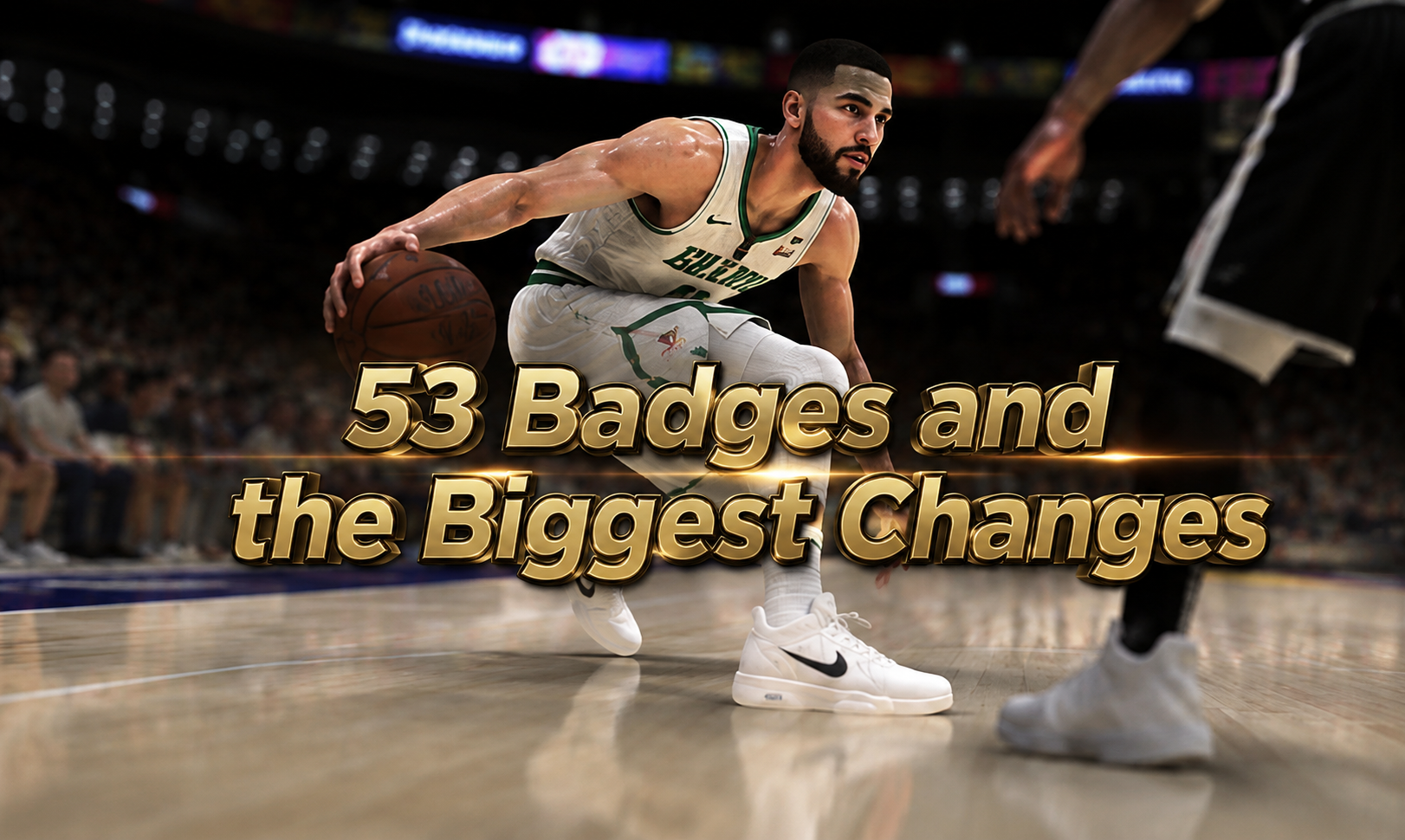
The badge system in NBA 2K27 has received one of its biggest overhauls yet. The total number of badges has increased from 40 to 53, with 19 new badges added and six removed. Returning badges have also been adjusted, so simply copying last year’s badge setup may not be the best approach.
The biggest change is the move toward specialization. Instead of having a few broad badges that cover several situations, NBA 2K27 gives players more specific tools for shooting, finishing, playmaking, defense, rebounding, and physical play.
What Changed With the Badge System?
The new system gives players more ways to build around a specific role. A guard who lives on the perimeter can focus heavily on shooting and ball handling, while a big can invest more heavily in finishing, rebounding, and interior defense.
Here are some of the notable new badges:
| Category | New Badge Examples | Main Focus |
| Shooting | Set and Fire, Arc Cadence, Static Middy | Spot-up and moving shots |
| Finishing | Post Spin Catalyst, Ghost Stepper | Post scoring and finishing |
| Playmaking | Pace | Ball-handler speed |
| Defense | Wall-Up, Ankle Braces, Seatbelt | Contests and perimeter defense |
| Rebounding | Crasher, Possession Closer, Sync Snatcher | Rebounding and possession control |
| Physical | Work Horse, Flash, Bruiser | Physical play and effort |
This doesn’t mean every new badge will be equally useful for every build. The important part is figuring out which ones actually support the way I want to play.
Shooting Badges Get More Specialized
Shooting has some of the most noticeable additions.
Set and Fire focuses on spot-up shooting, while Arc Cadence is designed around moving three-point attempts. Static Middy and Smooth Operator separate stationary and moving mid-range situations even further.
There is also Quick Trigger, which is aimed at faster shooting situations.
For me, this makes badge selection more interesting because I can’t simply look for one badge that improves every type of shot. I have to think about where my shots are coming from.
Finishing and Playmaking
The finishing category also gets some interesting tools. Post Spin Catalyst and Ghost Stepper give players more options around the basket and in the post.
For ball handlers, Pace is particularly interesting because it focuses on improving speed while carrying the ball. That could make a noticeable difference for guards who rely on quick changes of direction and attacking space.
The key is still balance. A badge is only valuable if I actually create situations where its effect matters.
Defense and Rebounding Receive Major Changes
Defense has also been given more specialized options.
Wall-Up improves two-hand defensive contests, while Ankle Braces and Seatbelt give perimeter defenders more tools to stay attached to ball handlers.
Rebounding is arguably one of the biggest areas of change. Badges such as Crasher, Possession Closer, Sync Snatcher, Boxout Boss, and Breaker create a much more focused rebounding system.
That means bigs may have to think more carefully about which rebounding badges match their role instead of simply equipping everything available.
Don’t Chase Every Badge
With 53 badges available, it can be tempting to spread everything around. I think that’s exactly what players should avoid.
The new system rewards specialization. If I mainly shoot threes, I would rather build a strong shooting package than waste resources trying to become average at everything.
The same idea applies when managing NBA 2K27 MT Coins. Whether I’m upgrading a build or working on my overall setup, I want to prioritize the things that actually improve how I play.
Legend Badges and Progression
Another important change is the way Legend-level badges are handled. Players can’t simply select Legend badges when creating a new build. They have to unlock them through progression.
That gives long-term development more importance. Instead of having the strongest badge setup immediately, I have to earn those higher levels through gameplay and progression.
It also gives me a reason to keep improving a build instead of treating badge selection as something that ends during character creation.
The NBA 2K27 badge overhaul is much more than simply adding extra badges. The larger system is clearly designed around specialization.
With 53 badges, more focused effects, and progression-based access to the highest levels, choosing the right badges should matter more than simply collecting as many as possible.
If you’re also thinking about 2K27 MT while developing your player or MyTEAM setup, the same rule applies: spend your resources with a plan.
For me, the best NBA 2K27 builds won’t necessarily be the ones with the most badges. They’ll be the ones where every important badge has a clear purpose and fits the way the player actually plays.